What is an Interactive Projection?
What is an Interactive Projection?
Interactive projection is a technology that turns physical surfaces, such as floors, walls, tables, or objects, into responsive digital environments that react to human movement and touch-like interactions.
Instead of passively displaying video or images like a traditional projector, an interactive projection system allows users to actively engage with the content. Movement, gestures, or physical objects placed in the projection area trigger real-time visual changes, animations, sounds, or effects.
In simple terms:
Interactive projection makes projected visuals behave like a living digital surface that responds to people in the real world.
How Interactive Projection Works
Interactive projection systems combine several technologies working together in real time. At a high level, they include four core components:
1. Projection system
A projector displays visual content onto a surface such as:
-
floors
-
walls
-
tables
These are typically high-brightness projectors designed for ambient-light environments.
2. Sensing or tracking system
This is what enables interactivity. It detects movement or presence using technologies such as:
-
infrared (IR) cameras
-
depth sensors (3D tracking)
-
cameras
-
motion sensors
The system continuously scans the interaction area and identifies:
-
where a person is
-
how they are moving
-
what objects are present
3. Processing engine (software)
A real-time software engine interprets sensor data and converts it into interactive responses.
It handles:
-
motion tracking
-
user input interpretation
-
triggering visual effects
This is the “brain” of the system.
4. Content layer
This is the visual and interactive experience itself.
Examples include:
-
animated games
-
educational simulations
-
immersive storytelling environments
-
reactive visual patterns
-
interactive branding experiences
The content is designed specifically to respond to user behavior or external inputs.
Types of Interactive Projection Systems
Interactive projection is not a single product, it is a category of systems that can be configured in different ways depending on the environment and use case.
1. Interactive Floor Projection
A system where the floor becomes a responsive digital surface.
Users can:
-
walk through animations
-
trigger effects with footsteps
-
play movement-based games
Common in:
-
museums
-
children’s exhibits
-
shopping malls
-
entertainment venues
2. Interactive Wall Projection
A vertical surface responds to gestures, touch-like motion, or proximity.
Users can:
-
interact with visual elements
-
trigger animations by waving or touching
-
explore educational content
Common in:
-
exhibitions
-
corporate lobbies
-
science centers
-
family entertainment centers
3. Interactive Table Projection
A tabletop becomes a shared interactive surface.
Users can:
-
manipulate objects
-
collaborate in group activities
-
play strategic or educational games
Common in:
-
classrooms
-
design studios
-
training environments
-
museums
-
zoos
-
aquariums
4. Immersive room systems
Multiple surfaces (floor + walls) are used simultaneously in a full-room interactive environment.
Users are fully surrounded by reactive visuals.
Common in:
-
immersive museums
-
themed attractions
-
branded experience spaces
-
family entertainment centers
What Makes It “Interactive” (Key Principle)
The defining feature of interactive projection is real-time feedback.
This means:
-
a user moves → the system detects it immediately
-
the software processes that movement
-
the projection updates instantly
This loop happens continuously, often multiple times per second.
The experience feels seamless when:
-
latency is very low
-
tracking is accurate
-
visuals are tightly synchronized with motion
Common Technologies Behind Interactive Projection
Different systems may use different technical approaches, but most rely on a combination of:
Computer vision
Cameras analyze movement patterns in the projection area.
Depth sensing
3D sensors measure distance and spatial positioning of objects.
Infrared tracking
IR light is used to detect presence and motion without visible light interference.
Real-time rendering engines
Software platforms generate dynamic visuals based on input data.
Where Interactive Projection is Used
Interactive projection is widely used in environments where engagement, learning, or experience design is important.
Museums and science centers
-
educational storytelling
-
artifact interaction simulations
-
immersive historical environments
Family entertainment centers (FECs)
-
motion-based games
-
group play experiences
-
immersive attractions
Education
-
interactive learning surfaces
-
collaborative classroom tools
-
sensory learning environments
Retail and brand experiences
-
product engagement zones
-
experiential marketing
-
interactive storefronts
Hospitality and public spaces
-
lobbies and waiting areas
-
event activations
-
themed environments
Benefits of Interactive Projection
1. High engagement
People naturally interact with movement-based systems, especially in group settings.
2. Physical + digital blending
It connects real-world space with digital storytelling.
3. Flexible environments
The same space can host multiple experiences by changing content.
4. Non-contact interaction
Many systems allow interaction without touching surfaces, which is useful in public or high-traffic areas.
5. Scalable experiences
Installations can range from small single-surface setups to full-room environments.
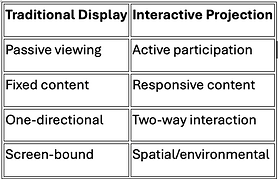
Interactive Projection vs Traditional Displays
This shift from “watching” to “participating” is what defines the category.
Limitations to Understand
While powerful, interactive projection systems have considerations:
-
Lighting conditions - High ambient light can reduce visibility unless high-lumen projectors are used.
-
Calibration requirements - Systems must be carefully aligned for accurate tracking.
-
Floor/wall surface conditions - Surface texture and color can affect projection quality.
-
Maintenance - Sensors and projectors require periodic cleaning and calibration.
The Future of Interactive Projection
The technology is evolving quickly, driven by:
-
improved AI-based tracking
-
more accurate depth sensing
-
lower-latency rendering engines
-
brighter, more compact projectors
-
integration with real-time generative content
Future systems are moving toward:
-
more natural gesture recognition
-
multi-user intelligent interaction
-
adaptive environments that change based on behavior
-
fully autonomous content generation
Summary
Interactive projection is a technology that transforms physical spaces into responsive digital environments. By combining projection systems, motion tracking, and real-time software, it allows people to physically interact with digital content in real time.
It is used across education, entertainment, museums, retail, and experiential design to create immersive, engaging, and adaptable environments.
At its core, interactive projection is not just a display technology, it is a bridge between physical space and digital experience.